I have chosen just three recipes as most of the ones I am trying I can't seem to get to do anything, or they don't do anything very exciting.
1) Party Lights [#48]
This is by far my favorite recipe. It emits particles from a point which the user can dynamically interact with. It has settings for glowing and streaks, all of which look very beautiful. I'm a huge particle fan for motion graphics to begin with.
2) Verlits [#41]
This is the first recipe I stumbled upon that I really spent a long time on and was inspired to get in and start tweaking it. There are a few points floating around, connecting to another point via a line. You can change the tension of the connected lines to make the unit behave as a very interesting organic whole. There is some default noise to the particles which make it move around in an interesting way by default.
3) Scrolly Brush [#44]
This one isn't actually that exciting, I thought it just functioned well. Basically you can paint on a surface, however as you paint the surface starts sliding away at a speed and direction you choose, but the image tessellates so whatever goes off one edge comes on the opposite so you can create interesting seamless patterns very quickly.
Sunday, September 20, 2015

Tuesday, September 15, 2015
Visual Music - Mapping Notes to Color
I found the section in McDonell's "Visual Music" on mapping sound to color to be the most interest.
Perhaps I just saw it first because it was one of the few pictures in the article, but reading about it was still very interesting. To know that it was Newton, a physicist, who was discovering similarities between music and visuals was very incredible.
I also liked the section afterwards where it talks about an old organ in 1877which opened curtains revealing colored stained glass representing each of the notes. So even back then there was a curiosity about the blending of music and visuals.
Perhaps I just saw it first because it was one of the few pictures in the article, but reading about it was still very interesting. To know that it was Newton, a physicist, who was discovering similarities between music and visuals was very incredible.
I also liked the section afterwards where it talks about an old organ in 1877which opened curtains revealing colored stained glass representing each of the notes. So even back then there was a curiosity about the blending of music and visuals.
Wednesday, September 2, 2015
Tuesday, September 1, 2015
Lorenz Chaos
The chaos I chose to use was known as the Lorenz system. I chose it because it sounded familiar from DiffEQ, but I was mistaking it for "Lorentz," which the Wikipedia article even opens by saying:
"the Lorenz equations, note it is not Lorentz"
The Lorenz system is a parametric function which when mapped over X, Y, and Z, creates somewhat of a mix between a figure-8 and a butterfly. I personally think it looks like two galaxies colliding.
There is not much else I can really say about it, as it's mostly differential equations and nitty gritty that I don't fully understand. I have to say however, it looks quite pretty.
Here is a video of it being formed:
https://www.youtube.com/watch?v=FYE4JKAXSfY
- David
"the Lorenz equations, note it is not Lorentz"
The Lorenz system is a parametric function which when mapped over X, Y, and Z, creates somewhat of a mix between a figure-8 and a butterfly. I personally think it looks like two galaxies colliding.
There is not much else I can really say about it, as it's mostly differential equations and nitty gritty that I don't fully understand. I have to say however, it looks quite pretty.
Here is a video of it being formed:
https://www.youtube.com/watch?v=FYE4JKAXSfY
- David
Monday, December 15, 2014
Pretty Sick Isadora Link
https://vjskulpture.wordpress.com/category/isadora-tutorials/
I wish I found this sooner, but it's full of awesome tutorials for Isadora.
I wish I found this sooner, but it's full of awesome tutorials for Isadora.
Saturday, November 22, 2014
LiveVibe TV, "Opening Minds: People Who Make Video Games"
I had to the
opportunity to work “Opening Minds: People Who Make Video Games.” Throughout the
week, we helped to set up cameras, audio, and the switcher board to make sure
the show ran smoothly. I was able to assist with audio, video, stage set-up,
lighting, and synchronization of picture and sound (clapperboard) during the
show. There was a nice crowd and the show was a success. One thing that I
learned from this show is that you must have many different elements to keep an
audience immersed. The house band and interaction kept the audience engaged.
Instead of there being down time while the audience had to sit and wait for the
next guest, the house band kept them entertained. Also, during the show, there
were many different components exhibited.
Samuel Sewall, Next-generation game programmer and developer, displayed
his game on the panel screen during his presentation. If that was not enough to
excite the crowd, Diana Reichenbach and Hyuk Jang invited audience members to
“Explore Ancient Egypt” and actually get a chance to test out their game.
Marko Suvajdzic,
owner of Organic to Digital, spoke about his five key elements of interactive
gaming: Gammification, Flow Theory, Educational Games, Data Collection, and
Adaptive Learning. Gammification is using the incentives that we use in video
games to help kids to learn. Kids are always willing to learn if the method of
learning is fun. The flow theory is a description of how to be fully engaged in
what we do. Suvajdzic proposed the question, “Video games fully immerse you,
but how do we do that for learning?” There are many distractions in the world
that cause kids to stray from learning in school. But, if we create more
educational games where students can have fun while learning, they will be
fully engaged while acquiring knowledge. Data collection is important to
tracking the success of educational games and what areas can be improved.
Suvajdzic stated “collecting data is useful because it stores information that
teaches us how to make education more efficient and make it better.” The last
concept was adaptive learning. Adaptive learning uses technology, more
specifically computers, to help teach students. Suvajdzic thought this concept
still had at least five years to develop before it is fully accepted and
teachers begin to use technology more for educational purposes.
I was not able to
take specific notes for Samuel Sewall, Diana Reichenbach and Hyuk Jang, but
they spoke about some very interesting topics. It amazed me that Sewall was so
young and heavily involved within his field. Similar to Suvajdzic, he spoke
about trying to find a way to make education more fun through gaming. His
expertise was coding and he explained some of his methods when creating a game.
He stated that at times his group would create a concept and idea and finish
creating a game within 24 hours. Reichenbach and Jang introduced a game created
for the South Florida Science Center. This was an interactive game that used
the Xbox Kinect to take students through Egypt and into the Afterlife. They
explained each step from the proposal and initial concept to body recognition
and creating characters.
Tuesday, November 18, 2014
Cremaster 3: Matthew Barney
I watched Cremaster 3 (2002). In the
beginning, I had no idea what was going on. There are lots of different types
of music and sound effects. Throughout the film, the music genre switches back
and forth multiple times. Also, a lot of the sound effects were very
dramatized. One thing that I took from Cremaster was that Barney wanted to
focus on how sound accompanies visuals. In one part, there was a person
spreading some material on a car. To the naked eye, someone may just think this
person is detailing or preparing the car for work. But since he added eerie and
high pitch squealing sound effects, it seemed like something crazy was about to
happen. After a few minutes, the film got very weird and actually was a little
bit scary with children carrying dead bodies and a lot of dark images. It was kind of sad to see them destroy such
nice cars. This reminded me a little bit of Fluxus artists when they destroyed
musical instruments and called it a form of art.
Monday, November 17, 2014
Matthew Barney's Cremaster Cycle and Björk's Work
After watching parts of Matthew Barney's Cremaster cycle, I can definitely say that this work is something like no other. It was my first time being exposed to something so grand, if I can use that word. While the cycle focuses on creation, it is only obvious that Barney's work is meant for mature audiences. While some people could find his work grotesque, I find it intriguing. He uses many different metaphors and allusions throughout his cycle, mainly in sexual ways. The camera shots in this piece are also phenomenal, as is the accompanying score.
I happened to find Björk's work more fascinating, perhaps because of its use of digital projection technology. I watched a few pieces, one of them being even more different than the others, called "Cocoon." From prior knowledge, the Japanese believe that the red string represents fate, and that it connects two people together romantically.
It really is a video you have to watch to understand it yourself.
https://www.youtube.com/watch?v=_fN-eotrifA

I happened to find Björk's work more fascinating, perhaps because of its use of digital projection technology. I watched a few pieces, one of them being even more different than the others, called "Cocoon." From prior knowledge, the Japanese believe that the red string represents fate, and that it connects two people together romantically.
It really is a video you have to watch to understand it yourself.
https://www.youtube.com/watch?v=_fN-eotrifA

Matthew Barney's Cremaster Cycle: a late night interpretation
Upon watching the first part of Matthew Barney's Cremaster Cycle, I found it amusing how Barney plays back and forth between a lingerie group flashing their skirts and what appears to be the lines of the football field, alternating between side to side and top to bottom. His syncing of music is right on for both shots in that they follow a sort of burlesque dance across the stage.His use of camera movement and focal length make it almost feel like the room is breathing and alive. For the most part, we should be able to see this happening a lot in traditional cinema, however we are trained to focus on the actor rather than the room around them in these dramatic swoops of the camera.
From the way Barney is sequencing his shots, it looks like two parties are going on in the opposing blimps. The two colors of grapes are the only distinguishing characteristic between the two rooms. The play on vertical and horizontal lines is a pretty strong theme in his first part as the legs are a huge emphasis in the beginning and at this point. There is the metaphor of the women's legs being as fine as porcelain as they are leaning out the window. This relationship is established during the overhead camera view in which all the legs are horizontal, much like the supporting structure of the centerpiece of the table. The guiding lines of the legs and the centerpiece would lead you side to side to make the comparison for yourself.
In addition to the lines, there is a voyeuristic sort of theme going on in the piece. The women start out as scantily clad and willing to show off what is underneath their skirts. On the blimp however, the dress style of the women appear to be quite prudish, almost like catholic school nuns. There is a lot of peeking at them from under the table, staring at their feet and crossed legs. It almost illustrates the subtle way men look at women when they aren't aware of it.
Barney seems to start a new sequence with the woman under the table. Due to the way she is dressed and the broken music box sort of background ambiance, it feels like we are staring at a broken doll that is laid to rest. I feel like the grapes illustrate a sort of male stimulation in which the movement conveys a stirring in the loins. The way Barney cuts from the prudish woman to the one under the bed shows, at least to me, that she is harboring some kind of sexual desire that she is keeping under the covers. They constantly stare out the window for the fear that someone is judging their outer appearance.It looks to me like the football field is masculinity portrayed as a monolith and the women are put on a pedestal way up in the blimps.
From the way Barney is sequencing his shots, it looks like two parties are going on in the opposing blimps. The two colors of grapes are the only distinguishing characteristic between the two rooms. The play on vertical and horizontal lines is a pretty strong theme in his first part as the legs are a huge emphasis in the beginning and at this point. There is the metaphor of the women's legs being as fine as porcelain as they are leaning out the window. This relationship is established during the overhead camera view in which all the legs are horizontal, much like the supporting structure of the centerpiece of the table. The guiding lines of the legs and the centerpiece would lead you side to side to make the comparison for yourself.
In addition to the lines, there is a voyeuristic sort of theme going on in the piece. The women start out as scantily clad and willing to show off what is underneath their skirts. On the blimp however, the dress style of the women appear to be quite prudish, almost like catholic school nuns. There is a lot of peeking at them from under the table, staring at their feet and crossed legs. It almost illustrates the subtle way men look at women when they aren't aware of it.
Barney seems to start a new sequence with the woman under the table. Due to the way she is dressed and the broken music box sort of background ambiance, it feels like we are staring at a broken doll that is laid to rest. I feel like the grapes illustrate a sort of male stimulation in which the movement conveys a stirring in the loins. The way Barney cuts from the prudish woman to the one under the bed shows, at least to me, that she is harboring some kind of sexual desire that she is keeping under the covers. They constantly stare out the window for the fear that someone is judging their outer appearance.It looks to me like the football field is masculinity portrayed as a monolith and the women are put on a pedestal way up in the blimps.
Sunday, November 16, 2014
Avant-garde artist with digital technology
After viewing multiple Bjork and Matthew Barney's artworks I found that avant-garde artists normally could follow the steps of digital technology. Because when they need to achieve their weird effects, digital technology is a good resource for them to rely on. Unique colour, sharp-cut theme, reshaped objects and unrestricted style, audience view them as avant-garde is largely determined by that they're unfamiliar with artists' magic technology. Of course, this not equals to that people who knows technology could creative them as well.
One of Bjork's was impressed on my heart which called Hyper ballad.
https://www.youtube.com/watch?v=26sP2WsA5cY
Bjork is lying on a digital projection screen with her eyes closed, then another Bjork projects on the former one, with her eyes opened and singing crazily. Multiple overlapped digital layers intwine with each other rhythmically, which draws a split situation for our viewers.
This is also could be interpreted as an excellent digital projection's application in art, I really like it.
Matthew Barney's works I think are a little bit bloody and irascible just as what he said.

One of Bjork's was impressed on my heart which called Hyper ballad.
https://www.youtube.com/watch?v=26sP2WsA5cY
Bjork is lying on a digital projection screen with her eyes closed, then another Bjork projects on the former one, with her eyes opened and singing crazily. Multiple overlapped digital layers intwine with each other rhythmically, which draws a split situation for our viewers.
This is also could be interpreted as an excellent digital projection's application in art, I really like it.
Matthew Barney's works I think are a little bit bloody and irascible just as what he said.
However, I have not to deny that his work sparks his endless intelligence and his thistly but valuable emotion.
Friday, November 14, 2014
Synaesthetic Synthesis: Simultaneous Perception of Harmonic Opposites
Youngblood has pointed out that cinema is newly defined by every person that creates a film. However that argument loses ground when we, as human beings, are only limited to define what we have access to; in other words, a pool of knowledge and resources available to the human race. In this way, the relationships defined may be new and never before observed.They aren't completely new, but rather a new derivative of what we currently have available to us. The only way something truly new is defined comes with the way of advancements in humanity and technology that would give us deeper insights into our understandings of nature and therefore a new element in the pool from which we can draw new and grander observations.
Thursday, November 13, 2014
Super Video Converter
http://www.erightsoft.com/SUPER.html
You can convert to any format of audio or video with it.
You can convert to any format of audio or video with it.
Blade Runner screening
Last week, I had the opportunity to attend a screening of Ridley Scott's Blade Runner. Professors Diana and James presented their take on the many themes existing in the movie and how this movie affected their career in some way or another. It was entertaining to say the least. It's been a while since I have last seen Blade Runner; when I initially watched it, I was with friends and I'll admit, we didn't pay much attention to the movie. I noticed multiples of themes in this movie, which contributes to its fame of being one of the most famous science fiction movies to date. Like most movies featuring a dystopian setting, topics arise along the lines of a deteriorating earth (pollution, lack of resources), unethical political systems, and the most important in this movie being genetic manipulation and cloning. You'll notice there are many extreme close-ups of human eye balls. In the movie, there is a test called the Voight-Kampff test that determines wether a being is human or replicant. As such, many characters' eyes are focused on screen in a way to let the audience know that his or her existence as a human or replicant is in question.
Sunday, November 9, 2014
Thoughts on Blade Runner
There are many movies produced by current filmmakers about human's future, but I believe that I finished my first real science fiction film until I have seen the movie called Blade Runner.
Actually, I couldn't understand every conversation when I watched, but I could still receive those cold-blooded,hopeless and lonely emotions in the film. Endless darkness and dirtiness in the street while temporary artificial light and delicacy in the room, which develops a great contrast to our audience.
Whether from macro environment setup or micro details design, this film is successful. I notice a detail related to character's eyeballs in the film. On the one hand, replicant's creator wore a pair of thick glasses, whose eyes are deformed beneath those glasses and finally, as a punishment, his eyes to be pierced by his replicant. Replicant Roy and his lover, their white part in eyes even more than their eyeballs. Further, the expensive owl which only has two empty eye holes and ridiculous eyeballs experiments for replicants' discrimination. On the other hand, Rachael, as a replicant who is implanted memory without knowing her real status, possesses two big, beautiful and storytelling eyes. In addition, When Roy at the end of his life, his sorrowful tears from his eyes in the rain.
There are multiple versions of the end, whether Deckard is replicant or not. I would like to share some of my personal thoughts at here. Firstly, I have read a book written by Haruki Murakami, unicorn in his book is a typical symbol of freedom and goodliness, so I think Deckard's dream also tells us he is looking for his happiness and his love. Secondly,abnormal Roy saves Deckard at the last second and he is full of sadness to express his last memory and feeling, helping audience jump out of action thriller to realize that even a replicant also could have two paradoxical mental sides, so as a human, which is the best way for us to cope with our replicant's problem? Whether it is possible that replicants to be more human while human to be more inhuman? Thirdly, memory is a magic thing. Because of memory, Roy hope he possess his real life; Because of memory, Rachael couldn't receive the truth of herself; Because of memory, Deckard finally finds out his own answer. Even though a person cannot forget everything in his life is torturous, we still need to remember what memories we got from our past experience, and to remember the feelings when we retrieve our memories, our memories prove our existence and our existence is our condition for everything.
Wednesday, November 5, 2014
Exploring Quartz Composer

- left is original, right is after a few random alterations
- added crystalize effect to the background that is attached to the patch time node
- added a blue effect to the dragon's body
- reduced the number of iterations for the body
- original video can be found here: http://vimeo.com/5697326
Global Closed Circuit: The Earth as Software
While I agree with Youngblood's assertion that television is the software of the Earth. I find the statement to be a bit dated now and find that the internet is the upgrade to this software. It has become much easier to track the social and psychological conditions of people, and therefore the environment, through social media and blogs. Thanks to the end user agreements, it is also possible to track the locations of specific social trends and such with the use of servers. The internet has essentially given us a higher resolution model of the human race which can almost be broken down to the separate individual. I say almost as there are still those without a social media profile or still refuse to use the internet.
Tuesday, November 4, 2014
The Technosphere: Man/Machine Symbiosis p. 180-207
I read “The Technosphere: Man/Machine Symbiosis” in the Gene
Youngblood text. This chapter spoke on the man’s right to be unique and the
relationship between man and machine. Some key items mentioned in the text were
the evolution of leisure and how computers are used in society. There is an
ongoing debate on whether computers make leisure a problem or if our culture is
one that demands leisure. I believe that it matters on which way you are using
computers. Although some may argue that playing video games all day is still
productive because they are therapeutic, improve motor skills, improve vision,
etc., I would argue that this form of computing makes leisure a problem.
Playing games and aimlessly surfing the Internet all day only becomes a problem
when it takes over one’s life and keeps a person from benefitting society.
Another interesting point of view that Youngblood had was that computers change
the meaning of life. He stated that we must learn how to live all over again
and intelligent machines are beginning to dominate man. I agree to some extent.
Society as a whole is becoming lazy when it comes to using our brains. We live
in a country today where it is very easy to just “Google” an answer to a
question rather than find a book or person to track down information. Why would
you scramble through several books for hours in a library when you can easily
search for an answer in a matter of seconds online? There are certain benefits
to both. While searching on the Internet may be faster, you will be able to
learn more in depth about a topic by doing research in the Library.
NO CLASS TODAY
Hello
There is no class today
You may use this time to start to develop your idea for your final project.
PP
There is no class today
You may use this time to start to develop your idea for your final project.
PP
Monday, November 3, 2014
Cybernetic Cinema pp.184-206
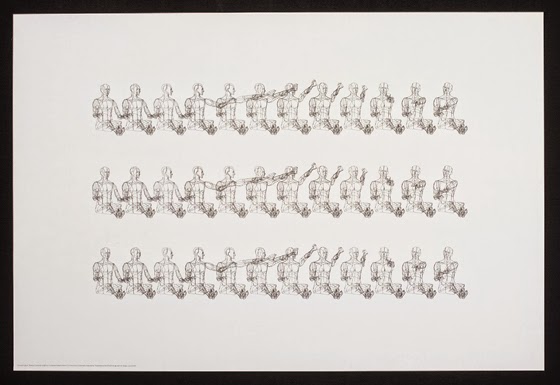
In this chapter, Youngblood gives examples of using computers to make films in the past. One of the examples indicates the mechanical analogue plotters draws pilot for computer-animated film by William Fetter of Boeing company. There are three key terms in this part which are online, off-line, and real time. It is said that no computer has the power to generate real-time images at that time so that computer art has to be made off-line. Meanwhile, Youngblood predicts that location shooting will be completely simulated with computers in the future.

Wave-Front Reconstruction: Lensless Photography
In 1947,
Dennis Gabor discovered the art of capturing and reconstructing wave fronts of
light at the Imperial College of Science and Technology in London. By reading the light waves in both intensity
and frequency, Dr. Gabor was able to record them by imprinting interference
patterns of light on a photosensitive surface.
The key is to key the light waves “cohesive” over distances to remain
“in phase”. He discovered that in order
to reconstruct a 3D image, he would need very cohesive light. His idea was to have light whose waves
traveled at one frequency. This did not
exist in 1947.
In 1960,
Dr. Theodore Maiman invented the laser, an acronym standing for Light
Amplification by Stimulated Emission of Radiation. This laser generated a beam of light that was
totally coherent since it was all one wavelength. Later, in 1965, Emmett Leith and Juris
Upatnieks used the laser in a modification of Gabor’s original holographic
technique to produce the first completely successful three-dimensional
image. They used a prism to create two
beams from one laser. To reconstruct the
image, a second laser is directed at the hologram from the same position.
My first
memory of seeing a hologram was at the Haunted House at Disney World in
1973. I think it was a hologram. It was 3D inside a glass globe. Now I’m not sure if it was. Does anyone know if it was/is a hologram?
Subscribe to:
Posts (Atom)